In order to add the Fibonaccitimeextensions drawing to chart, choose it from the Active Tool menu. Specify begin and end points of the trendline and extension line; the retracement levels will be calculated automatically.
This technical analysis guide covers the use of Fibonaccitimeextensions. We explore what data traders gather with extensions, how they’re drawn up on a chart, and what trading insight they give.
Unlike Fibonacci retracements and Fibonacciextensions in price, which focus on identifying potential reversal or extension levels, Fibonaccitimeextensions are used to forecast potential time-based turning points in the market.
FibonacciTimeZones are a lesser-known aspect of the Fibonacci sequence, which is widely used in trading to identify potential reversal and extension levels in price. In this guide, we’ll explore how you can use FibonacciTimeZones to pinpoint entry and exit levels and improve your overall trading performance.
FibonacciExtension levels provide objective, data driven zones where a strong trend is likely to pause, consolidate, or reverse. Here's how to use them.
Fibonacci Time Extensions are a powerful temporal analysis tool that applies the famous Fibonacci sequence to time intervals rather than price levels. This technique helps traders identify when significant market turning points are likely to occur based on natural mathematical relationships.
There are several options for identifying FibonacciTime Clusters, including using FibonacciTime Zones, Fibonacci Fans, and Fibonacci Arcs. Each of these options has its advantages and disadvantages.
Fibonacciextensions is a tool that traders can use to establish profit targets or estimate how far a price may move. Extension levels are also possible areas where the price is expected to reverse.
Article discusses the basics of Fibonacci retracements and extensions with links to new research. Written by internationally known author and trader Thomas Bulkowski.
To use FibonacciTimeExtension, we measure the duration of a trend or swing using the Fibonacci sequence. Then, we project these Fibonacci ratios into the future to predict when the next significant move is likely to happen.
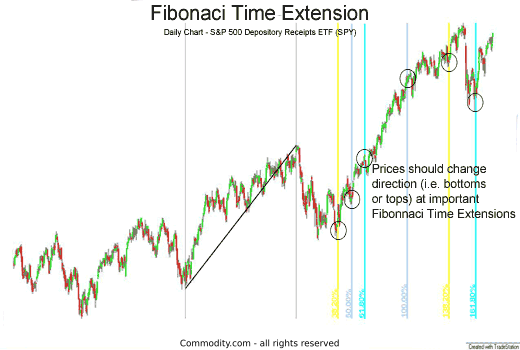 This technical analysis guide covers the use of Fibonacci time extensions. We explore what data traders gather with extensions, how they’re drawn up on a chart, and what trading insight they give.